
Dear Families,
I hope you are enjoying the summer and staying cool! I wanted to take a moment to update you on the progress Walnut Square has made during the 2024-2025 school year. Our school community has collaborated and worked hard to support our Superstars as they learn to read and read to learn. To keep you informed, I’ve included information from our 2024-2025 School Improvement Plan and the progress we’ve made towards our Reading SMARTIE goal. You can click on the slides to view detailed information, or feel free to scroll down to read through the progress update directly. Please contact me if you have any questions. Thank you for your continued support!
Sincerely,
Jen Rubera
Principal
SMARTIE Goal: By June of 2025, 90% of all students who are scoring below grade level on the Fall 2024 Reading iReady Diagnostic will achieve 100% progress toward their Stretch Growth measure on the Spring 2025 Reading iReady Diagnostic.
79% of students at Walnut Square School in grades K-3 performed below grade level on the Fall 2024 iReady Reading Diagnostic. Our SMARTIE goal is a very ambitious goal where students performing below grade level will achieve 100% progress toward their Stretch Growth Measure.
On the Spring 2025 Reading iReady Diagnostic, 48.4% of students who scored below grade level on the Fall 2024 Reading iReady Diagnostic met or exceeded 100% Stretch Growth. Based on this SMARTIE goal, the goal was not met. However, this is not because there wasn’t a significant achievement…it’s because the goal was not a realistic goal. National data suggests that achieving 100% of Stretch Growth is a significant accomplishment. Some research indicates that nationally, around 20% of students are able to reach stretch goals (from Curriculum Associates). This highlights that it’s a challenging, but achievable, target for a portion of the student population. When creating SMARTIE Goals for the 2025-2026 school year, it is important to remember this, and it is recommended that the goal be revised to balance ambition with realistic achievement.
Reviewing the iReady data, it’s important to consider both typical and stretch growth.
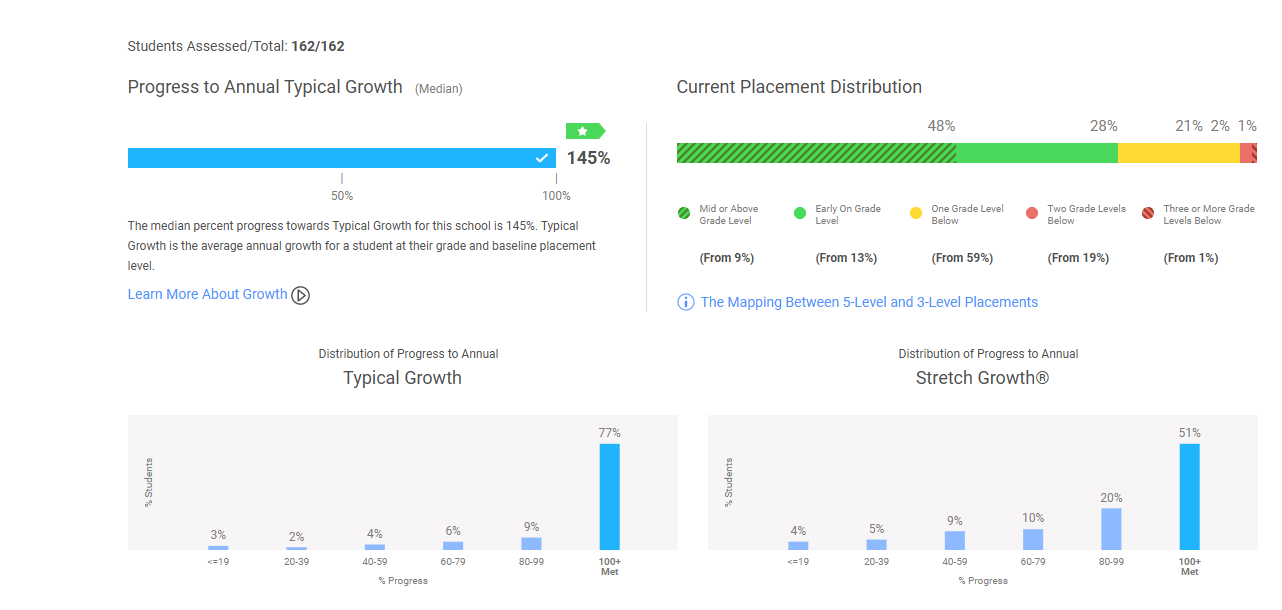
iReady Reading Spring 2025 Diagnostic Growth by Grade
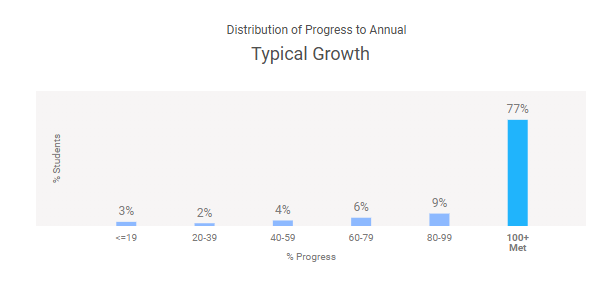 77% of students met or exceeded 100% Typical Growth in Reading. What does this mean? It means that the vast majority (over three-quarters) of Walnut Square students are making at least the expected amount of reading progress for students with similar starting points nationwide. Many are progressing at an even faster rate.
- Significance: This points to a highly effective core reading instruction program. It suggests that Walnut Square’s foundational reading skills, phonemic awareness, phonics, vocabulary, comprehension instruction, and overall literacy instruction are successfully supporting the expected growth of most students. This is a very robust performance against national benchmarks.
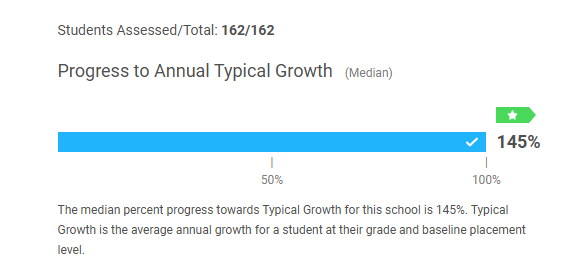 The median percent progress towards Typical Growth for this school is 145%. What does this mean? The median means that if you lined up all Walnut Square School students’ individual percent progress towards Typical Growth from lowest to highest, the student in the middle achieved 145% of their typical growth goal. “145% of Typical Growth” means that the average (median) student at Walnut Square School grew 45% more than what is considered typical for a student like them.
- Significance:
-
- Exceptional Learning Environment: This indicates that Walnut Square School provides an environment where students are consistently making much more than expected progress in reading. It’s not just that many students are reaching 100% typical growth; the middle student is significantly exceeding it.
- School Culture: This speaks to the depth and consistency of Walnut Square School’s reading instruction, engagement strategies, and overall school culture that fosters significant academic advancement.
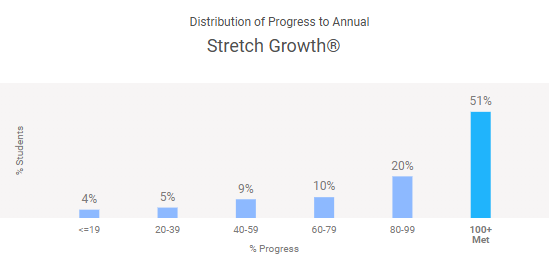 51% of students met or exceeded 100% Stretch Growth in Reading. What does this mean? This is an outstanding achievement in Reading. As discussed before, Stretch Growth is an ambitious target, with national averages typically around 20% of students achieving it. Walnut Square School is achieving this for over half of the students in reading.
- Significance:
-
- Skill Acquisition: A significant portion of Walnut Square School students are making accelerated gains in reading, which is critical for closing achievement gaps quickly for those below grade level and for advancing the literacy skills of those on or above grade level.
- Impactful Differentiation: This suggests that Walnut Square School’s differentiated instruction, interventions, and enrichment opportunities in reading are highly effective in pushing students well beyond typical growth expectations.
- Strong Foundational Literacy: Achieving this level of stretch growth speaks volumes about the depth and effectiveness of Walnut Square School’s reading curriculum and teaching practices.
Putting This All Together: The Bottom Line
According to the SMARTIE goal in Walnut Square’s 2024-2025 School Improvement Plan, we didn’t meet it. However, when you look at multiple data points from the iReady Reading Diagnostic, it tells a different story.
- Walnut Square students are making a lot of progress: Walnut Square students are demonstrating strong academic momentum: 77% are making expected progress or more, and an impressive 51% are accelerating their learning to meet ambitious stretch growth goals.
- Teachers are teaching, and students are learning: The median progress of 145% towards Typical Growth is evidence of an effective teaching and learning environment in reading. It suggests that Walnut Square School instructional practices are consistently leading to significantly above-average gains for students.
- All students can succeed: Students, whether starting below, on, or above grade level, are experiencing significant and/or accelerated growth. This minimizes future learning gaps and prepares students for subsequent grades.
Next Steps:
Review and analyze data for the 23% of students who did not meet Typical Growth and the 49% who did not meet Stretch Growth. Review attendance and behavior data as well as WIN block intervention and assessment data. Are there common factors? What supports or interventions could be implemented to refine our MTSS model so we have more students reaching typical and stretch growth?